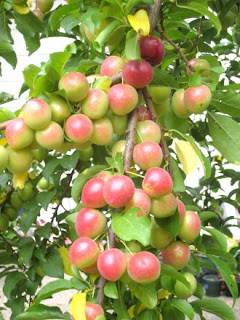
This is a ground cherry

We found some in a local Farmers' Market and I decided to try to grow some. I planted the seed in pots in the early spring and they soon sprouted.

They were ready to transplant into the garden in late March.
 They grew like weeds, literally. I found that in some parts of the country they invade vacant property and take it over. They soon showed that characteristic in our garden.
As the fruit matures and ripens the papery covering turns brown and the fruit drops to the ground, hence the name "ground cherry".
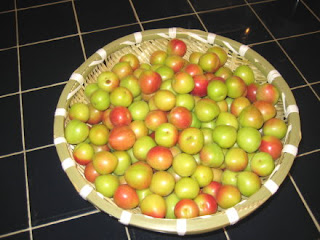
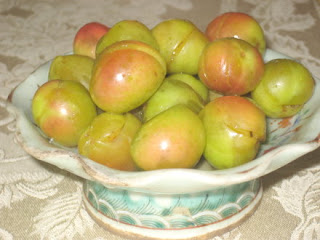
 The right plate is the ground cherry as picked up and the left is the ground cherry fruit after removing the outer husk.
The fruit has a distinctive taste, somewhat like a pineapple-flavored tomato with lots of small hard seeds. Sandra dipped some in white chocolate and it has a much different taste - even more delicious.

Recently I looked at ground cherry information on the web and found that it has been planted in Taiwan and is known as the lantern fruit. It is said to be detoxifying, an aid in controlling diabetes, an antitussive, and a diuretic. So, just eat a few at a time.
A few days ago we picked up some and gave to a friend to take home. She gave some to her children to eat. Later we asked her daughter how she liked it. She replied that it was bad, “Tasted like paper”. We found out that she had eaten the whole thing including the papery husk. When I asked her mother if she had told her to peel it first she replied, “That’s just common sense”.
Fortunately, there is information that indicates the outer covering can be used as a tea that has a detoxification effect. This incident reminded me of the time we gave our friends some jongdz; we had to remind them to remove the bamboo leaves before eating.
The Four Seasons Hotel in Hong Kong serves a tart with ground cherry at their afternoon tea. I don't think it can compare in elegance or taste with the one prepared by Sandra.




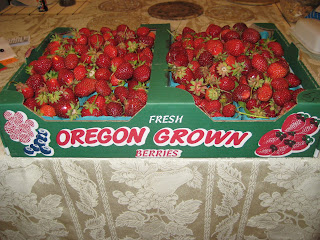 Well, we decided that the price was a bit higher than we wanted to pay for berries to cook down and can so Sandra decided that she wanted to try another U-Pick adventure. We located a farm about a 10 minute drive from the house and started out this morning loaded with empty boxes for our haul. When we arrived we noted that there were workers picking in one of the fields.
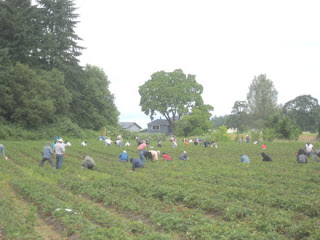 They were loading small buckets with berries and dumping them into large barrels.
 They were "stripping" the plants of all mature berries, ripe or not. The filled barrels were then transported to a warehouse to await transport to a plant making jam and other strawberry products.
 Well, enough of that, Sandra wanted to get down to business so we staked out a row and started picking. The plants were full, some berries already over-ripe. The plants grow close to the ground so you had to bend over or squat down to reach them.
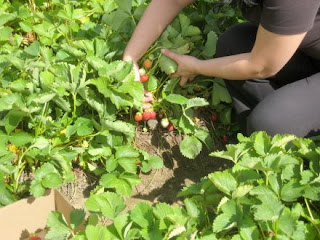 After about an hour we had all had enough and decided that U-Pick was not the best way to get strawberries even if the price was about half that of already picked berries. We gathered about 18 pounds during that hour's time.
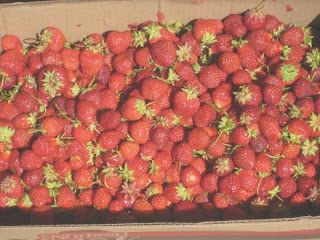 We were accompanied by some friends from Taiwan and their kids. The two girls really took to the picking, being very selective and only getting the perfect berries.
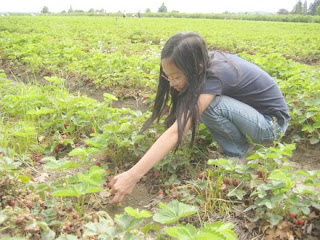 In fact they enjoyed it so much we are thinking about hosting a group of kids from Taiwan next summer to experience the joy of living in the Pacific Northwest.
 The English name comes from Paeon or Paean, a student of Asclepius, the Greek god of medicine and healing. Supposedly Asclepius became jealous of his pupil; Zeus saved Paeon from the wrath of Asclepius by turning him into the peony flower. Tree peony (Mudan) and herbaceous peony (Shaoyao) are placed in the same genus and family. The leaves and flowers are similar, but the former is an arboreal plant with a permanent woody branch structure, while the latter is a perennial herbaceous plant with new growth each year from ground level. Tree peony and herbaceous peony both are beautiful and charming flowers and have prestigious reign in the flower world. The tree peony is known as "the King of flowers", whereas herbaceous peony is called "the Queen of flowers".
  Tree peony has been the favorite flower from the imperial rulers down to the common man for more than 1500 years in Chinese history, whereas the cultivation history of Chinese herbaceous peony can go back to 2500 years ago. During the Tang Dynasty (618A.D.-907A.D.), Empress Wu Ze Tian and Princess Tai Ping were supposedly drinking in the Imperial Flower Garden and admiring the snow when they were greeted by the fragrance of flowers; it was the aroma of wintersweet, which was in bloom. Empress Wu Ze Tian rewarded the wintersweet but to her disappointment, she found only wintersweet, winter jasmine, and narcissus blooming in the garden. She wrote a poem and sent it to the god in charge of flowers, which read “Tomorrow I’ll visit the garden; let me know that spring has come. All flowers are to bloom tonight; don’t wait for the spring breeze to blow.” The next morning, hundreds of flowers bloomed and the garden was full of Springtime. But the tree peonies stubbornly disobeyed the order and refused to bloom.

 It sprouted and produced six stems, one with a flower bud. We should have cut the bud off to allow the plant to grow another year but we couldn’t wait to see what it looked like.
  The bud never fully opened.
  The grounds are open to the public from May 1st through June 15th; the remainder of the time they are concentrating on growing flowers for exhibits and for sale to the public. The Adelmans have taken Best of Show awards for six of the last eight years at the American Peony Society’s annual competition.
 They cultivate both tree peony and herbaceous peony as well as an intersectional peony which is a cross of the two.
 but the majority of their business is the sale of root sections with eyes that are planted in the fall and will produce blooms the following spring.
 I was surprised to see peonies in almost every color except blue (that’s the grower’s dream color).
  Groups of flowers


 Fields stretched as far as you wanted to walk


