Monday, August 30, 2010

Gardening? no - Fishing? Yes

First, an update on the Mason Bee project. We have had cold weather much later than normal this year. As a result, the Mason Bees didn't hatch until after the apricot trees bloomed. So, no apricots again this year. The bees did nest though as you can see below.
Now I will wait until November to open the nesting block and see if I have any viable cocoons to clean and prepare to hatch next Spring.

The apricots will be given one more chance. One tree is being cut back to four 3" diameter main trunks and the second is being severely pruned. Hopefully one of these techniques will result in apricots next year. Otherwise the space will be used for something we can harvest.

The cold weather has delayed the garden production dramatically. Last year we were harvesting in early June. This year it was late July or early August for most crops and we still don't have a ripe tomato. Of course the zucchini are producing.

So, what do you do? Go Fishing!

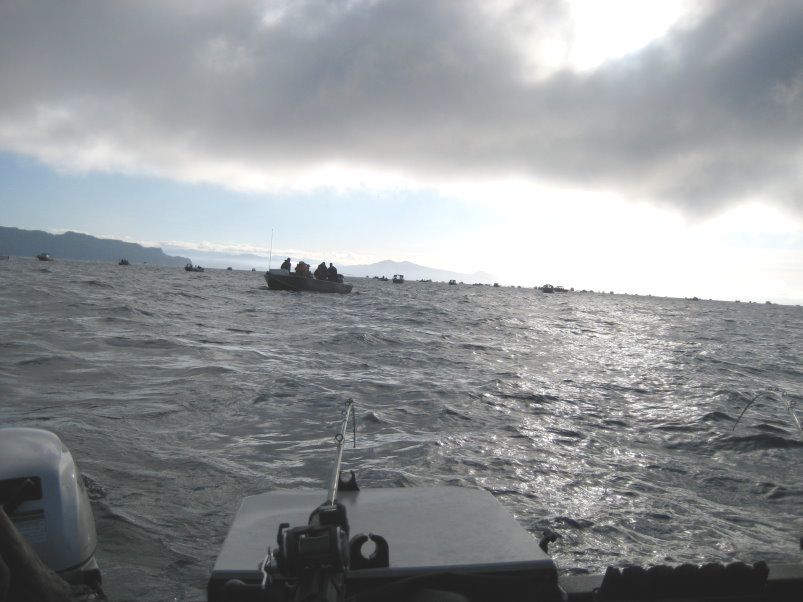
My daughter Stephanie made arrangements for me to accompany her along with some friends on a salmon fishing trip. Sandra gets seasick on the dock walking to the boat so she stayed home. You have to get an early start so I left home at 3AM to drive to Stephanie's house then we drove another hour and fifteen minutes to the coast. We put the boat in at Hammond, OR - near the mouth of the Columbia River. There wasn't much light at 6AM. It was a 30-minute ride to the area we were fishing. Along the way the sun came up but it didn't feel much warmer. It was 53 degrees NOT counting the wind chill from a 25 mph boat ride or the spray. I had on a tee shirt, long-sleeved denim shirt, sweatshirt, and an insulated windbreaker. That didn't do much for my face! Next time I will wear a wet suit - I was soaked in no time.
Our guide was Shanon; she runs a charter called "Let's Go Fishing" and is well known in the area as one of the few female guides and one that will bring in fish if there are any being caught. The day before she finished second in the Salmon Derby with the next-to-largest fish. Oregon has very tight controls on sport fishing. You must have a license of course but in addition in order to fish for salmon, halibut, or sturgeon you must have an additional license. A one-day license costs $16.75. It includes a tag on which you have to record each catch with type of fish (8 different kinds of salmon), where caught, length, and date. Failure to do correctly can result in a $300 fine. Also, you cannot keep "wild" Chinook or Coho salmon in order to maintain the species. Whew, glad the guide knows all about this.

We were about 500 feet away from the dock when one of the guys said "Wait, I left the box of food on the dock." We went back and got it. He didn't realize then but he also left the ice chest with the food (fried chicken) and the beer. He didn't discover that until mid-morning when Stephanie and I took out our sandwiches for "brunch". He was most concerned about the beer (a 24-can pack) but Shanon was concerned about the lunch which he was bringing. I gave her a banana and she had some cookies and a couple of cupcakes to tide her over until we got back to the chicken on the dock.

Over 1,000 boats put out today, and there was a lot of jockeying for position. The technique was to speed out and troll back in; then repeat - and repeat. We fished from 6AM until 4PM. I caught the first fish. It was early in the first run and we weren't completely ready. The fish made a run for the boat and I called for the net - no net. The tackle was very light and no way to get the fish in the boat without a net. Besides the guide must determine the fish can be legally caught before bringing it into the boat; otherwise it is released while still in the net. The fish made another run at the boat and actually ran into it - still no net. On the third run in the fish decided to run under the boat and caught the leader breaking the line. Oh well, I caught the first fish anyway. The boat was actually a "jet sled" seating six. It was almost a flat-bottom and there was a lot riding up and splashing back down on the way out. Also, no seat belts! On the final run we were a LONG way out and coming back against the tide so there was a LOT of splash and spray. I was very glad that I took along a change of clothes for the ride home.Three happy fishermen (fisherpersons??). I was happy too just to have the experience. Stephanie caught a Chinook and the other two are Coho. No one wanted the fish heads so Sandra has them for fish stew or grilling salmon cheeks. Stephanie graciously shared hers with us. Sandra wants us to go back and while we are fishing she will hang round the place where they clean and dress the fish and collect the "unwanted" heads. That will be another blog entry.
Well now it's sit and wait for the tomatoes to get ripe!


Thursday, January 14, 2010

With a Little Help From My Friends (the Mason Bees)

The first spring we were in our new Oregon home we had trees blooming that we had to identify as no one told us what they were. The first to bud had beautiful pink buds reminiscent of the apples and cherries we had heard of that grew here.

After about a week the buds multiplied and began to open.

The more they opened the less they looked like cherries or apples. We recognized them as either peach or apricot flowers.
As summer progressed we were only able to count 6 fruit on the two trees. As they matured they took on a golden color and eventually we harvested the best tasting apricots we had ever eaten. But we were puzzled, why not more fruit?

We met an elderly gentleman with a fruit orchard nearby and asked him what was wrong. He explained that the temperature changes here on the south side of the Columbia River were too late for the bees to arrive and pollinate the apricots; peaches, cherries, pears, plums – OK but not apricots.

We heard about Orchard Bees or more commonly Mason Bees which are now being used by growers to assist in the pollination of their crops as the honeybee population is decreasing dramatically. They are native to the Pacific Northwest and thrive in the cool damp climate, even working in a light rain. They are solitary and every bee works. Unlike honeybees they do not produce honey.

We wanted apricots. So in March, before the trees bloomed, I went to a local supplier to get some Mason Bees for the 2009 season but it was already too late since they emerge in late-February or early-March. He said to order them as a Christmas Present. BUT, we still wanted apricots. So, I got a Q-tip, climbed the ladder, and hand pollinated as many flowers as I could reach. I must not have looked enough like a bee because none of the flowers produced fruit.

The bees are smart – really smart. The female starts laying eggs as soon as she has mated and can collect pollen. She lays eggs in a hole that must be between 9/32” and 5/16” diameter and 8” to 10” deep. Very picky. She collects pollen and lays an egg on a mass of pollen at the back of the nesting hole and seals the chamber with mud. She continues laying eggs until the hole is full and seals the exit. She will lay one to two eggs a day over a lifetime of four to six weeks.

The interesting thing is that she lays female eggs deep in the hole and male eggs near the opening. So, if the nesting tube is disturbed the males are sacrificed so the egg-laying female can survive.

The eggs hatch a few days after laying and develop in the chambers, feeding on the pollen during the summer. By fall they are mature and stay in the chambers over the winter, emerging only when the temperature is consistently above 55 degrees and the fruit trees are blooming.


This year we got a head start. I got on the contact list of the bee supplier and bought some of the first bees that came in. They come in two forms, nesting tubes and washed cocoons. The tubes are a gamble, may contain from zero to 6-8 cocoons.
I bought 5 tubes and harvested 13 cocoons.
The washed cocoons are a sure thing.The cocoon pack contained 10. Price wise it was almost a wash - $1.00 vs. $1.15.
We also bought a nesting/cocoon-collecting house. There are nesting blocks inside and a place to put the cocoons prior to hatching.
Now to put the house in a south-facing location, load it with cocoons, and wait. THIS YEAR I WILL EAT APRICOTS! (or cut the trees down and replace them with something else that I can harvest)

Tuesday, November 10, 2009

Things That Go BOOM In The Night

We have friends who have a vineyard but no buyers for their grapes. We accommodate them by picking the grapes and making raisins and wine. Last year we made about 40 pounds of raisins and several quarts of wine. This year we harvested Pinot grapes and decided to make some sparkling wine to drink in few weeks rather than waiting for a year as we did before. The grapes were beautiful.
After a light rinse we placed them in glass jars along with a "starter" that Sandra uses for making fermented rice. We thought that should give it a boost and start fermentation quickly.
Sure enough, after a few days the action began and bubbles and froth developed. After a week we decided to rack the liquid and separate it from the grape skins. Since we wanted a sparkling wine we decided to place it in soda bottles, since they would withstand the pressure developed during further fermentation and contain the carbon dioxide so we would have the fizz.
We "vented" the bottles daily and after another week racked a second time and had a beautiful product, so nice that we bottled some and gave it to a friend to sample.
We kept the remainder in three soda bottles in the garage where the temperature was about 50 degrees. We expected the fermentation to slow and end within a few days. One day I forgot to vent the bottles. The following evening we were sitting in the family room and heard this loud BOOM. We looked at each other, looked around to see if something had fallen from a high shelf, and then started searching for the source of the noise. Then I thought of the bottles in the garage. Upon opening the door to the garage we were greeted by the aroma of our sparkling wine which was now spewed all over the floor, car, storage shelves, freezer, and yard tools. Thankfully only one bottle had exploded and it split sideways and didn't spray the roof. I backed the car out of the garage and hosed it off while Sandra moved the wet bottles and boxes to a dry spot on the floor. I vented the other bottles while she mopped and we called it a night. The next day we washed down the floor and wiped the bottles before replacing on the shelves. We now were short 1/3 of our "vintage" but we are diligent about venting it every night whether it needs it or not!

Wednesday, October 28, 2009

Remembering......


I was a freshman in college when the Vietnam War was beginning. Student, marriage, children, and critical skill deferments kept me in the US during these years. I had friends who went and never returned; friends who returned physically but were never quite the same afterwards, and friends who returned to jeering crowds yelling "Baby Killer" and other epitaphs. I had tried to put these memories behind me until a few weeks ago when they were brought poinantly home.

We were meeting a friend at the Portland, Oregon airport; her flight was unexplainedly delayed. We took a seat in the waiting area and were there just a few minutes when I noticed what I thought was a motorcycle club entering. They were dressed in jeans and each wore a denim vest with embroidery on the back that I was too far away to read. Most had long hair and some had greying ponytails; several were using canes and one was in a wheelchair. Each one was carrying a furled American Flag, full size. They formed into lines along each side of the hallway from the gate area to the waiting area. They just stood there as if waiting for something to happen. My wife asked me if something had happened but I told her that if it had there would be a TV crew there.

After about 15 minutes the group unfurled their flags; the leader was looking at a printed copy of a photograph. Passengers began to enter the waiting area. A young man dressed in civilian clothes and carrying a backpack approached the waiting area and the group came to attention, saluted, and then shouted "Welcome home soldier". People in the waiting area broke into applause. Members of the group came up to him individually and shook his hand, exchanging a greeting. A lump came into my throat then even as it is now as I write this. What a different greeting than these men had received when they returned for you see - they were a group of Vietnam veterans who have committed to meeting every returning US serviceman who arrives at the Portland airport. I have later learned that there similar groups throughout the United States.

We are living through troubling times but let us never forget to honor the men who are fighting for our right to live in a free country.

Friday, October 16, 2009

Chestnut Harvesting Time is HERE

October is chestnut harvesting time in Oregon. We always go to a farm owned by the Carson family in Hillsboro, Oregon. They grow chestnuts, hazelnuts, and kiwi fruit. Today was the first weekend they were open for U-Pick chestnut harvesting. We have been the last two years and enjoy talking with the family and exchanging chestnut recipes. They have several varieties of chestnut trees, most are about 30 years old.
You need to wait for the nuts to drop off the tree and the enclosing spiny hull to dry and open. There are usually green and brown husks under the trees. You can collect nuts from either but the brown husks indicate that the nuts have begun to dry and the starch has started to convert to sugar. In both cases the nuts will need to be "dry-cured" several weeks before eating.
This year was a bumper crop as you can see from the clusters of nuts on this tree.
The pods begin to crack open when the nut is mature and will soon drop to the ground.
We had to wear gloves to protect our hands when picking up the pods or opening them. One easy way to open the pods is to step on them and release the nuts inside.
The spines are very sharp and will go through even leather gloves if you aren't careful.
Each pod will have between two and four nuts inside.
We harvested 20 pounds in about an hour. We will go again next week introducing some of Sandra's Taiwan friends to this fun pastime.

If you're interested and live in the area the farm is located at:
7110 SW Straughan Road, Hillsboro, OR 97123
So plug the address into your GPS or Google it and tell the Carsons that Michael and Sandra sent you.

Last Harvest

We have had our fill of zucchini and yellow squash, time to look towards the pumpkins and butternut. Temperatures are dropping and we decided to do a final harvest before frost is on the pumpkin. We let one cucumber grow to full size for next year's seed. Some tomatoes will remain to see just how late we can harvest. The ground cherry plants will stay to see if they winter over, it's the first year we have planted those.
We have been looking forward to the grape harvest; last year we processed about 200 pounds as raisins or a "beverage". Last week our friends said they needed about one more week to reach full ripeness. THEN, over the weekend the temperature dropped to 21 degrees and all of the grapes froze - just a lot of mush now. So, we now better understand the risk farmers take trying to provide food for our needs. Oh well, for us there's always next year.

Saturday, October 10, 2009

Crabbing - Oregon Northern Coast

Our daughter went crabbing with some friends on the Oregon Northern Coast. They went out in a boat for several hours and each caught their limit. She was generous and shared with us.
First the crabs had to be cleaned and prepared for cooking. BIG DECISION - how to prepare them. We settled on stir fry with lots of garlic.
Sandra took about 8 cloves of garlic for each crab.
Chop the garlic finely, and stir-fry it in oil until it is golden brown.

Remove the garlic and add about a tablespoon of dried red pepper flakes and fry until fragrant.

Cut the crab into four pieces and dredge with flour.

Stir-fry the crab in the oil until it is done, adding some chicken bouillon powder and salt.

When the crab is done add chopped green onion and the fried garlic and heat until the onion is softened.

Serve with steamed bread.
DON’T discard any leftover garlic residue. It is great added to rice congee.
As you can see, there wasn't anything left. In fact it was so tasty that I bought a license and went out to catch our own crabs this past Friday.

We went to a jetty near Nehalem Bay on the Oregon coast. They rent the traps and I wanted to try it out before I invested in my own traps. The license which allows you to catch 12 crabs per day was $6.50 and the traps rented for $8.00/day including a rotting fish for bait. We went with another family and took the fixings for lunch and hot pot in case we were hungry and didn’t want to eat the crabs we caught “on-the-spot”. We even decided how we would divide our catch among our friends since 12 per family would be more than enough.
They even have a pot to boil your crabs if you want to eat them there at one of the many tables provided surrounding a communal fire pit.
They rent boats if you want to go out into the channel but we decided to crab from the floating dock.
Well, to make a long story short we “crabbed” all afternoon. Throw the trap out – wait 20-30 minutes – pull the trap in – inspect the catch. You are only allowed to keep male crabs measuring over 5-3/4 inches across the back of the shell.
I caught 33 crabs – and brought none home. All the large crabs were female and the males were too small to even measure. My friend and his daughter caught over 40 crabs – same results.
We thought about buying some crabs at the pier but had second thoughts. There will always be another chance; in fact my friend is out today at another location. MAYBE he will share his catch.