Goji (枸杞) are also known as Wolfberries. I was first introduced to them when I was living in Taiwan. They are used in cooking, both savory and sweet dishes, as well as in herbal remedies. My wife would often prepare a soup using them to boost our immunity. In the US they are now referred to as the "super fruit" as they contain many nutrients, phytochemicals, vitamins, and minerals. (see end of article for detailed list) They can also be eaten like raisins as a snack.
When we were in Taiwan we would always buy goji at the herbalist. After moving to Oregon, there was no convenient herbalist but we did find dried goji at the Asian market. I am always wanting to try new things so I thought why not try to grow some. I didn't know how the berries were dried or if the drying temperture was so high that it would prevent them germinating. So, I took some of the dried berries and planted them in potting soil and placed them in a sunlit window along with my other garden starts and waited. Tomatoes sprouted, peppers sprouted, beans and cucumbers sprouted, but no goji. I waited out the entire spring to no avail. Then I happened to see a documentary on the
Ningxia Hui Autonomous Region of north-central China. It mentioned that the area produced about 30 million pounds of goji annually. When I saw the producing fields and heard them talk about the temperature variations in the region with temperatures ranging from 102oF to -22oF I had an idea.
So, maybe the cold winters were necessary for conditioning the seed. I placed some of the seed in our freezer and waited three months. This time the seeds germinated within a week.
I transplanted the seedlings and watched them grow into spindly-branched plants. I then pruned several and took the largest one and put it out in our garden. After a season of waiting, the plants all dropped their leaves without blooming. This past spring, three years after sprouting, the plant in the garden was about three feet tall but still spindly. I decided to wait until fall before pruning it.
Last week, as I was picking tomatoes, something caught my eye. There was one red berry hanging on the uppermost branch of the goji plant. I had not even seen it bloom. Now I am encouraged and this fall will move all the seedlings out to the garden, prune them, and wait for an abundant harvest next summer.
Wolfberries contain many nutrients and phytochemicals including
- 11 essential and 22 trace dietary minerals
- 18 amino acids
- 6 essential vitamins
- 8 polysaccharides and 6 monosaccharides
- 5 unsaturated fatty acids, including the essential fatty acids, linoleic acid and alpha-linolenic acid
- beta-sitosterol and other phytosterols
- 5 carotenoids, including beta-carotene and zeaxanthin (below), lutein, lycopene and cryptoxanthin, a xanthophyll
- numerous phenolic pigments (phenols) associated with antioxidant properties
Select examples given below are for 100 grams of dried berries.
- Calcium. Wolfberries contain 112 mg per 100 gram serving, providing about 8-10% of the Dietary Reference Intake (DRI).
- Potassium. Wolfberries contain 1,132 mg per 100 grams dried fruit, giving about 24% of the DRI.
- Iron. Wolfberries have 9 mg iron per 100 grams (100% DRI).
- Zinc. 2 mg per 100 grams dried fruit (18% DRI).
- Selenium. 100 grams of dried wolfberries contain 50 micrograms (91% DRI)
- Riboflavin (vitamin B2). At 1.3 mg, 100 grams of dried wolfberries provide 100% of DRI.
- Vitamin C. Vitamin C content in dried wolfberries has a wide range from 29 mg per 100 grams to as high as 148 mg per 100 grams (respectively, 32% and 163% DRI).
Wolfberries also contain numerous phytochemicals for which there are no established DRI values. Examples:
- Beta-carotene: 7 mg per 100 grams dried fruit.
- Zeaxanthin. Reported values for zeaxanthin content in dried wolfberries vary considerably, from 2.4 mg per 100 grams to 82.4 mg per 100 grams to 200 mg per 100 grams. The higher values would make wolfberry one of the richest edible plant sources known for zeaxanthin content.Up to 77% of total carotenoids present in wolfberry exist as zeaxanthin.
- Polysaccharides. Polysaccharides are a major constituent of wolfberries, representing up to 31% of pulp weight.


 We also took along the "Bear Necessities" - Bear Mace and an air horn. The bears like huckleberries too. It wouldn't do to surprise a bear OR to be surprised by a bear. So, we were advised to make a lot of noise to let them know we were around.
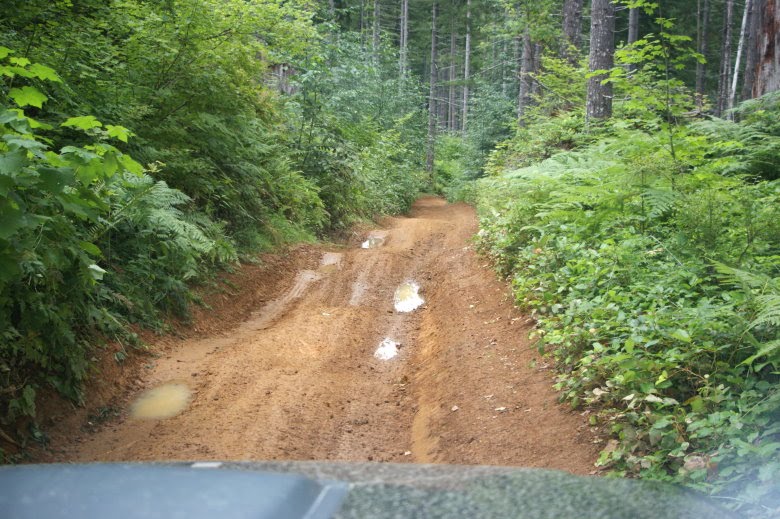
 We left the main road and entered the forest at Brown's Camp. The area is well marked with trails for walking, biking, cycling, ATVs, and off-road vehicles. Not the kind of roads you would want to take your drive-to-work car on. The trails are graded from "one diamond" to three diamonds". We stayed on the "one diamond" trails today but saw some others along the way. I'll cover the off-road adventure in another post.
 The noise of our cars must have scared him away. He was actively "harvesting" material to build onto his already large dam.
 The road was not too bad and the scenery breathtaking. It was about 53 degrees with a light breeze, perfect weather for our trip.
 The forest has been logged for a long time and we saw the remains of huge trees along the way.
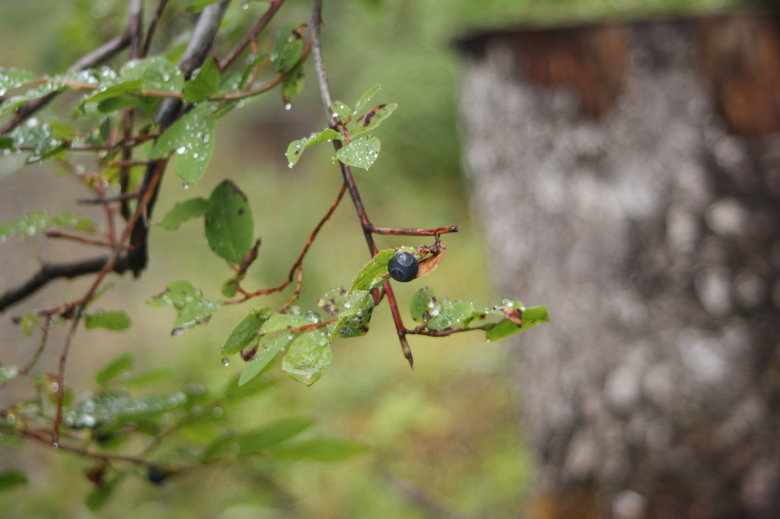
 Someone shouted "Stop, there they are!" So we stopped and sure enough found bushes with red berries on them growing on the decaying stumps.
 Out came the containers and the work began.
 We found a few more bushes growing nearby, also with red berries.


 Oh, did I mention we were travelling logging roads? And that
  But, this meant that there would be loaded logging trucks coming out on this road. So we continued broadcasting our position and looking for any sign of trucks coming. We soon came upon the staging area where the trucks were being loaded. Companies contract for logging certain areas of the forest.

 Along the way we stopped for lunch and came upon some black raspberries. The taste was different from any of the berries we had picked at farms around the area.
 We were now off the logging road and getting close to "the area" where we should find more huckleberries bushes.
 And find them we did, this time the